A porcelain slab wall is a feature wall covered in large-format porcelain panels — usually printed with a marble or stone pattern — so the wall reads as a few big, continuous surfaces instead of tile. Most porcelain slab feature walls we build cost $8,000–18,000 and take 3–6 days; double-height walls run $15,000–30,000 and take up to about 10 days. Send a photo of your wall and we’ll give you a price range the same day.
What a porcelain slab wall is and who it suits
Large-format porcelain slabs are thin, flat panels that come in sizes far larger than regular tile. On a wall, that means very few seams and a look close to book-matched stone, at a fraction of the weight. Porcelain doesn’t need sealing, handles humidity well, and wipes clean, which makes sense for Florida homes.
A slab wall suits:
- living rooms with a tall or wide TV wall where wood or paint feels too plain;
- homes with modern or contemporary interiors and large open spaces;
- great rooms with vaulted or two-story ceilings, where the wall is visible from upstairs;
- owners who want the look of stone without the weight and upkeep of natural marble;
- smaller statement walls — an entry, a dining room, a bedroom wall behind the bed.
Porcelain slab wall options
Slab accent walls
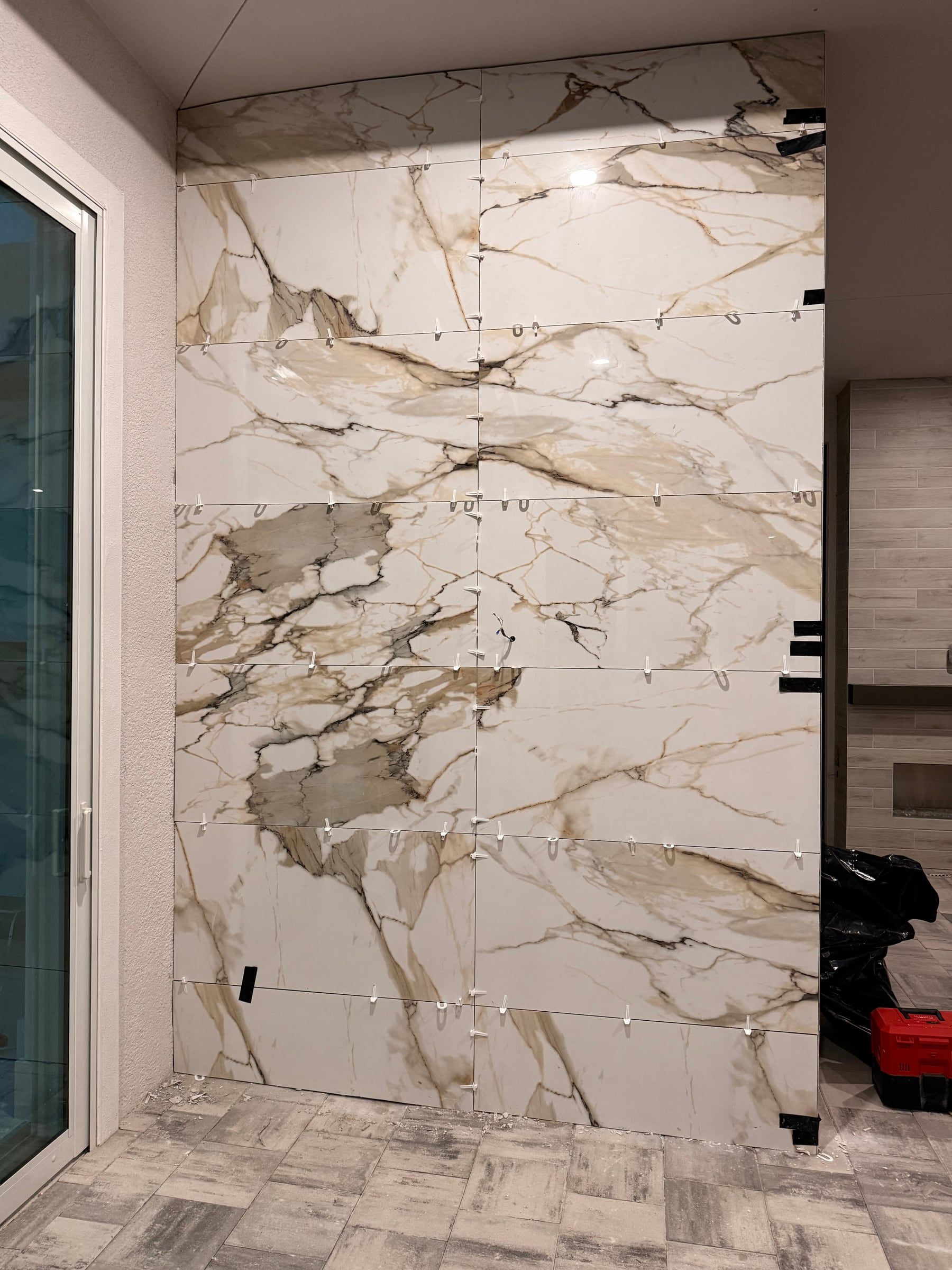
A single wall covered in slab, without a TV or fireplace. Our Winter Garden wall was 5 ft by 10 ft in large-format marble-look porcelain, built in three days for about $5,500. That’s below our typical range because the wall was small and simple.
Slab media walls
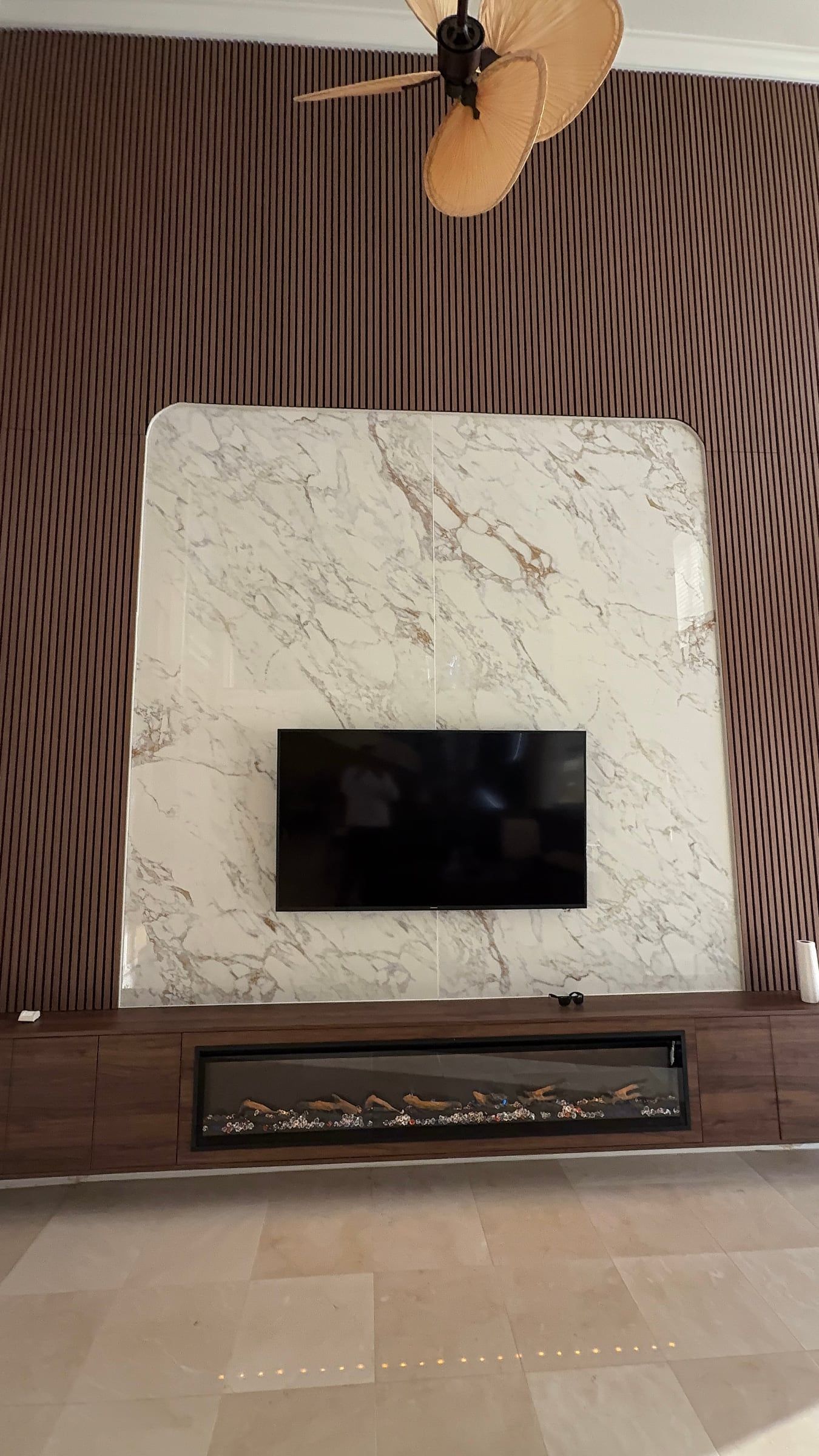
Slab in the center of a media wall, around the TV and fireplace, often with wood slats or built-ins on the sides. In Melbourne we built a marble-look slab media wall with slat sides and a fireplace for about $16,000. Our TV media walls page covers TV height and wire concealment.
Slab fireplace walls
Slab surrounding an electric fireplace, with or without a TV above. The fireplace opening is laid out in the slab before cutting so the pattern frames the unit.
Double-height slab walls
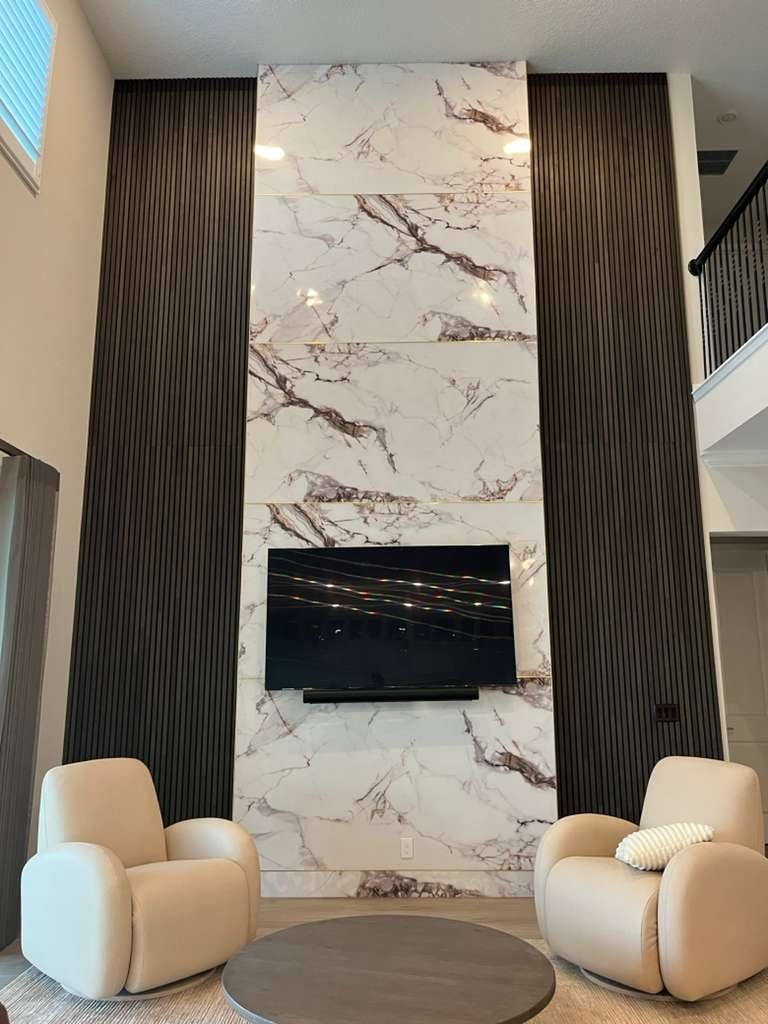
Double-height slab walls run from the floor to the ceiling of a two-story room. They typically cost $15,000–30,000 and take up to about 10 days. This is the largest work we do, and it’s where porcelain makes the most sense: natural stone at that height would be extremely heavy, and tile would mean hundreds of joints.
Our flagship project is a double-height porcelain slab media wall in Sarasota, finished in July 2026. Porcelain slabs run to the ceiling, with dark wood slats, a linear fireplace, built-ins and wainscoting. It took 10 days and cost about $30,000.
What makes double-height walls different:
- Access. Scaffolding or rolling towers are needed for most of the job, and the room has to have space for them.
- Handling. Large slabs are lifted and set by several people at once. On these jobs our crew of three grows to as many as six.
- Layout. With so much visible surface, seam placement and pattern direction matter more. We plan the full elevation before the first cut.
- Structure. The wall has to be flat and solid over its full height. Framing or backing is added where it isn’t.
- Lighting and the upper wall. Many double-height walls include lighting or a change of material up high, which needs planning with the electrician.
Materials
- Large-format porcelain slabs, usually in marble-look patterns, in matte or polished finishes.
- Marble-look PVC panels, a lighter and less expensive alternative for center panels. We used one in a Sarasota media wall with wood slats, built-in shelving and a tray ceiling detail.
- Wood slats on the sides of a slab center.
- Framing, backing board and adhesive suited to the slab and the wall.
- Trim and edge profiles for outside corners and transitions.
Porcelain slab compared with other finishes
Porcelain is not the right answer for every wall. Here is how it compares with the other finishes we install:
- Versus wood slats. Slats are warmer and less expensive. Porcelain gives a cleaner, stone-like surface and a more formal look. Many media walls combine both: slab in the center, slats on the sides.
- Versus marble-look PVC panels. PVC panels are lighter and cost less, and they work well for a center panel. Porcelain is harder, more scratch-resistant and looks more like real stone up close.
- Versus tile. Tile has many grout joints. Large slabs have only a few seams, so the pattern reads as one surface.
- Versus natural marble. Natural stone is heavier, needs sealing, and costs more. Porcelain gives a similar look with less weight and less upkeep.
Choosing a slab
Look at a full slab, not just a small sample, if you can. Marble-look patterns vary a lot across a large panel, and a vein that looks subtle on a sample can be bold across a whole wall. Matte finishes hide fingerprints and reflections; polished finishes look more like polished stone but show glare from windows and lights. Tell us where the TV and windows are when you choose, because a polished slab behind a TV can reflect light.
What drives the price
- Wall area and height. More slabs, more handling. Height adds scaffolding and crew time.
- Slab choice. Size, thickness, pattern and finish change the material cost.
- Openings. Fireplace and TV cutouts, outlets and niches require precise cuts.
- Pattern matching. Matching veins across seams uses more material and more layout time.
- Wall preparation. Uneven walls need backing or framing.
- What else is on the wall. Fireplaces, built-ins, slats and lighting add their own cost.
Our process
- Send a photo of the wall with its width and ceiling height.
- Price range the same day. Evenings and weekends, the same business day.
- On-site measurement at a time that works for you. No trip fees anywhere in Central Florida.
- Design, final quote and 50% deposit. We lay out slab sizes, seams and openings, and confirm materials.
- Build. Most slab walls take 3–6 days; double-height walls up to about 10.
- Walkthrough and final 50%.
- 1-year workmanship warranty. Slabs, fireplaces and lighting carry their manufacturer’s warranty.
Denys Herhel has worked in finish carpentry and interior finishing since 2016 and in Florida since 2022. We’re fully insured — $1M general liability, certificate of insurance available on request.
Technical details
Timeline
A typical slab wall: wall prep and framing, electrical rough-in, backing, slab layout and cutting, setting slabs, trim and edges, then fixtures, TV and cleanup. On double-height walls, setting the slabs alone can take several days.
TV and fireplace
Openings and blocking are planned before slabs are cut, because changes after cutting are expensive. Typical TV placement puts the center of the screen near seated eye level, higher with a fireplace below. Final dimensions follow the TV and fireplace manufacturer’s installation manual.
Electrical
All electrical work — outlets, hardwired fireplaces, integrated lighting — is performed by a licensed Florida electrician. Outlets and boxes are positioned before slabs go up.
Hiding wires
Cables run inside the wall or build-out to recessed boxes behind the TV. Adding a cable path after slabs are installed is difficult, so we settle this during design.
Room preparation and cleanup
Clear the wall and the floor in front of it — more space for double-height work. We protect floors and furniture, manage cutting dust and slurry, and clean up daily.